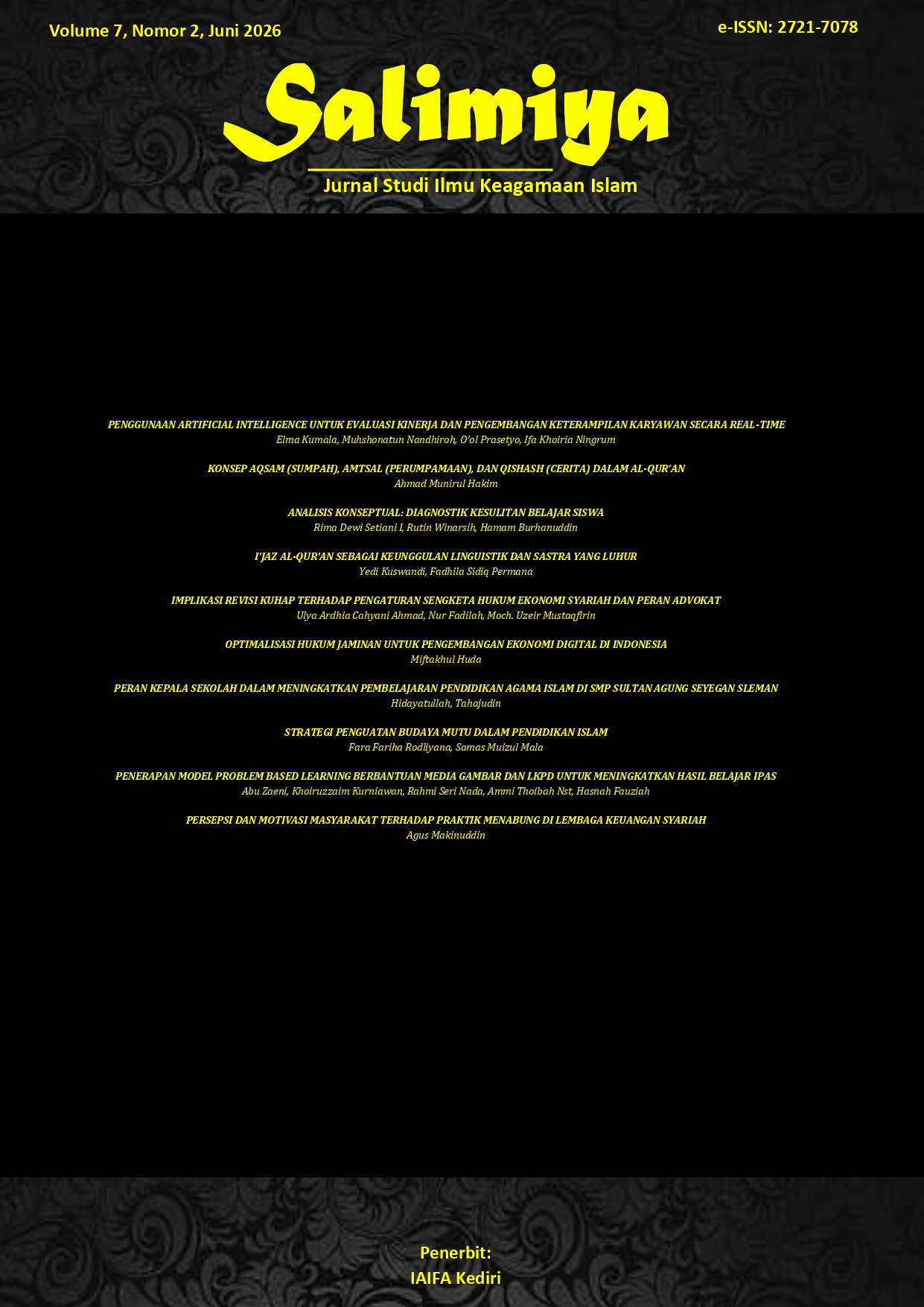
TANTANGAN DAN PELUANG: TRANSFORMASI SUPERVISI AKADEMIK GURU PENDIDIKAN AGAMA ISLAM DI ERA DIGITAL
DOI:
https://doi.org/10.58401/salimiya.v7i2.3523Keywords:
academic supervision; Islamic Religious Education teachers; e-supervision.Abstract
Digital transformation has reshaped educational practices and created an urgent need to reform academic supervision, particularly in Islamic Religious Education (IRE). Academic supervision, which has traditionally emphasized administrative compliance, must evolve into a professional development process that is responsive to technological advancement while preserving Islamic values. This study aims to analyze the transformation of academic supervision for IRE teachers in the digital era, identify the major challenges in its implementation, and explore opportunities and strategies for optimizing digital-based supervision. The study employed a library research approach with a scoping review design. Data were collected from reputable national and international scholarly publications published between 2016 and 2025, retrieved through Google Scholar, SINTA, DOAJ, and ERIC databases. The data were analyzed using content analysis and thematic analysis. The findings indicate that academic supervision is shifting toward e-supervision, which utilizes digital platforms to enhance the effectiveness of teacher professional development. However, its implementation continues to face several challenges, including disparities in digital literacy, inadequate technological infrastructure, resistance to organizational change, and difficulties in assessing the affective and spiritual dimensions of IRE teachers. Nevertheless, digital supervision offers significant opportunities through real-time data management, personalized feedback, and the establishment of virtual Professional Learning Communities (PLCs) to strengthen teachers' professional competencies continuously.
Downloads
Published
Issue
Section
License
Copyright (c) 2026 Salimiya: Jurnal Studi Ilmu Keagamaan Islam

This work is licensed under a Creative Commons Attribution-ShareAlike 4.0 International License.